
Corrosion Under Insulation (CUI): The Silent Threat to UAE’s Industrial Assets
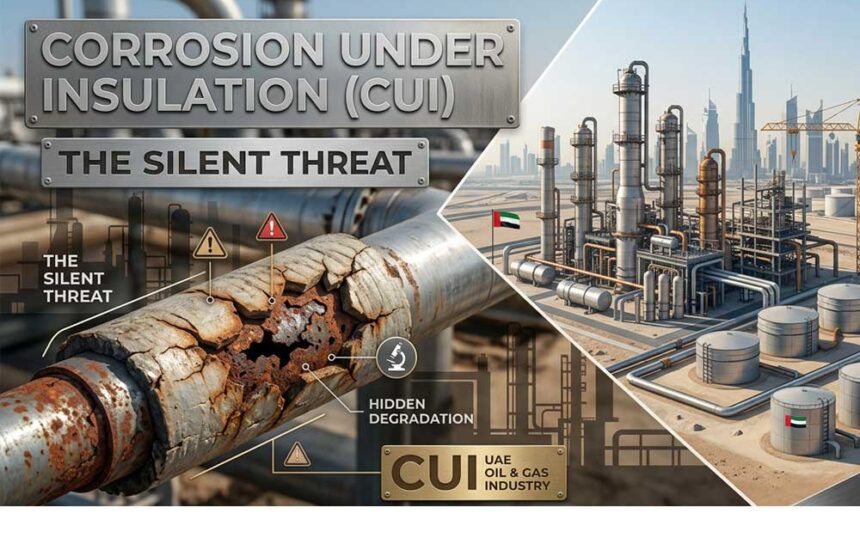
Some corrosion is easy to deal with. You see it, you assess it, you fix it. CUI isn’t that kind of problem. It happens underneath insulation that’s doing exactly what it’s supposed to do on the outside, which is why a pipe or vessel can look completely fine while it’s quietly losing wall thickness underneath. By the time anyone notices, it’s often not a maintenance issue anymore, it’s a failure.
This is one of the more underestimated risks facing insulated piping and vessels across the region, and it deserves more attention than it usually gets
Why CUI Is So Hard to Catch
Insulation systems are built to keep moisture out, but no system is perfect forever. Once water gets in, whether from rain, condensation, deluge systems, or a small breach in the weather jacket, it gets trapped between the insulation and the metal surface. That combination of trapped moisture, warm operating temperatures, and a metal surface creates close to ideal conditions for accelerated corrosion.
The insulation that traps the moisture also hides the evidence. A visual walk-around won’t catch it. You can look at a perfectly intact jacketed pipe for years and have no idea that the wall thickness underneath has dropped by half. That’s what makes CUI different from most other forms of corrosion: the very thing that protects the asset is also the thing that conceals the damage.
Certain zones make the problem worse. Pipe supports, nozzles, flanges, and any point where insulation is penetrated or damaged are classic trouble spots. Dead legs and low-flow sections, where temperatures sit in the range most favorable to corrosion, tend to be repeat offenders as well.
NDT Methods That Actually Work Against CUI
Stripping insulation off every pipe and vessel to check for corrosion isn’t realistic at scale, so inspection has to work through the insulation rather than around it. A few techniques have become the standard toolkit for this
- Pulsed eddy current (PEC) is one of the most widely used methods because it can measure average wall thickness through insulation, weather jackets, and even some coatings, without removing anything. It's a fast screening tool, which makes it useful for scanning large areas and flagging where wall loss is showing up before committing to more detailed follow-up.
- Guided wave testing takes a different approach, sending low-frequency ultrasonic waves along the length of a pipe from a single access point. It's particularly useful for long uninsulated or insulated pipe runs, since it can screen substantial lengths without needing insulation removal at every foot of pipe.
- Infrared thermography helps locate wet insulation zones by picking up temperature differences on the surface, which often correlate with trapped moisture underneath. It won't quantify corrosion on its own, but it's a strong tool for narrowing down where the problem areas likely are.
In practice, these methods work best together. PEC or thermography identify the areas of concern across a wide area, and more targeted techniques like ultrasonic testing confirm the actual remaining wall thickness at those specific points. Using one method in isolation almost always leaves gaps.
Large daily temperature swings between day and night create condensation cycles inside insulation, effectively feeding moisture into the system on a repeating basis. Add in intense UV exposure, which degrades weather jackets and sealants faster than in cooler climates, and insulation systems age and develop entry points for water sooner than their design life would suggest.
Prevention vs. Failure: The Real Cost Comparison
A CUI inspection program has a cost. So does insulation repair and coating maintenance. Compared against a failure, none of it comes close.
A localized CUI failure on a pipe or vessel typically means unplanned shutdown, emergency repair costs at a premium, and in more serious cases, a product release with environmental and safety consequences. Add in the potential for regulatory penalties, insurance complications, and reputational damage if the failure is significant enough to draw outside attention, and the numbers stop being close.
Preventive inspection, by comparison, is scheduled, budgeted, and far less disruptive. It also gives you options: recoat, patch, or replace a section proactively, instead of dealing with an unplanned failure that takes the equipment out of service without warning. The math almost always favors catching CUI early, even before you factor in safety.
Why the UAE Climate Makes This Worse
Climate conditions here don’t just make CUI possible, they make it more likely and faster-moving than in milder environments. High humidity, particularly along the coast, keeps moisture levels elevated for much of the year, and that moisture finds its way into insulation systems through even small gaps or damaged jacketing.
Large daily temperature swings between day and night create condensation cycles inside insulation, effectively feeding moisture into the system on a repeating basis. Add in intense UV exposure, which degrades weather jackets and sealants faster than in cooler climates, and insulation systems age and develop entry points for water sooner than their design life would suggest.
Combine that with facilities that often run continuously at elevated operating temperatures, and you get an environment that checks nearly every box for accelerated CUI risk.
Staying Ahead of It
CUI doesn’t announce itself, which is exactly why a targeted inspection program matters more than a visual walk-around ever will. The tools exist to catch it early. The question is whether they’re actually built into your inspection schedule before insulation failure turns into asset failure.
PTC supports clients across the UAE with ASME Authorized Inspection, Third-Party Inspection, and Advanced NDT services for critical equipment and assets.
If you’re reviewing your inspection program, our team would be happy to discuss where PTC can support.
#CorrosionUnderInsulation #CUIInspection #NDTTesting #PulsedEddyCurrent #GuidedWaveTesting #AssetIntegrity #IndustrialInspectionUAE #CorrosionManagement #PTCInspect #OilAndGasUAE