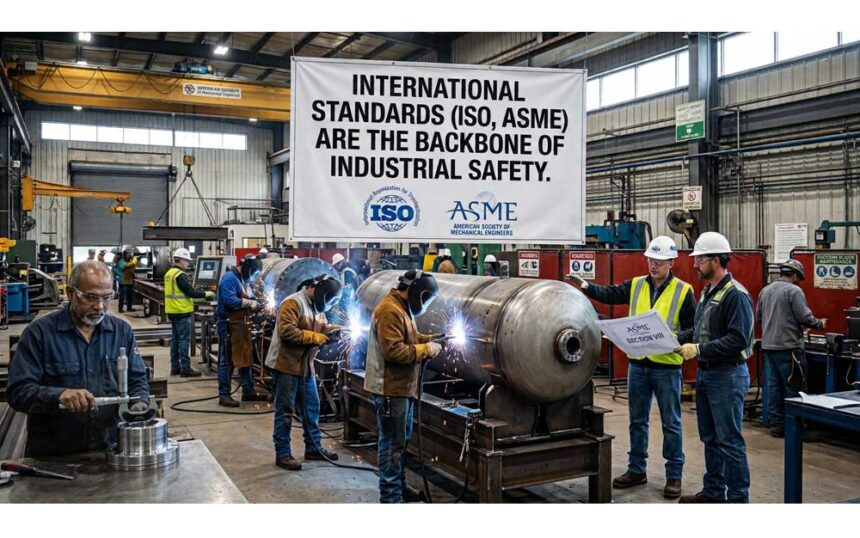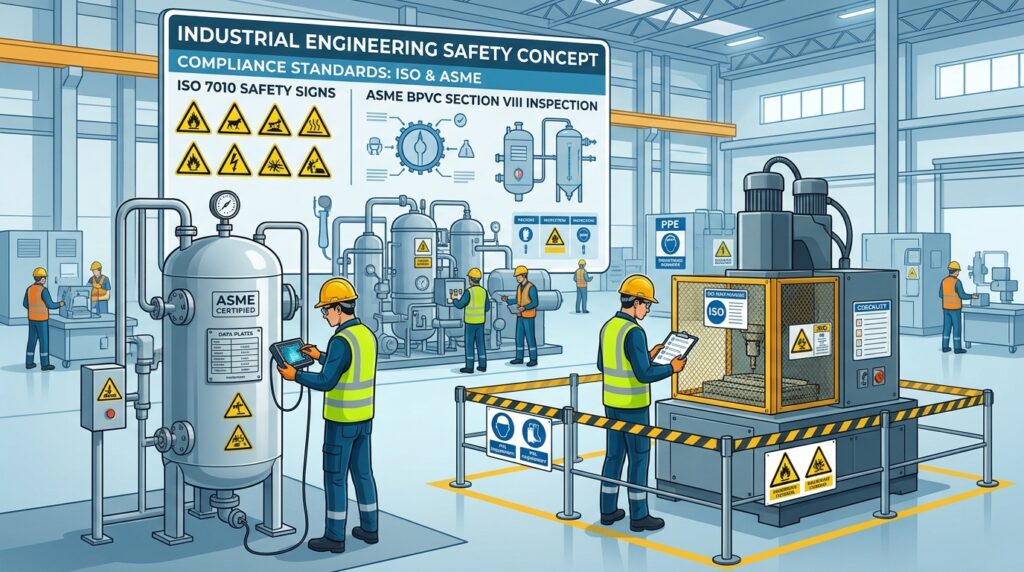

WHY INTERNATIONAL STANDARDS (ISO, ASME) ARE THE BACKBONE OF INDUSTRIAL SAFETY
Every October, the industry marks World Standards Day on the 14th, honoring the quiet infrastructure of agreed-upon rules that lets a valve made in Germany fit a pipeline in Abu Dhabi, or a pressure vessel certified in one country get accepted into service in another without anyone having to start the conversation from scratch. Most people never think about this system until it’s missing. Then a piece of equipment gets rejected, a shipment gets held up, or a client asks a question nobody can answer with confidence, and suddenly the value of a shared standard becomes obvious.
Here’s what a few of the standards that matter most in this industry actually certify, why sharing them across borders matters as much as it does, and what’s actually at risk for a UAE company that treats international alignment as optional.
What ISO 9001, ISO/IEC 17020, and ASME Each Actually Certify
These three get lumped together constantly, but they certify completely different things, and knowing the difference matters.
- ISO 9001 certifies an organization’s quality management system. It’s not specific to inspection or any particular industry. It confirms that a company has consistent processes for meeting customer requirements, tracking nonconformities, and improving over time. A manufacturer, a hospital, and an inspection firm can all hold ISO 9001, and it says the same basic thing about each of them: their internal processes are structured and consistent.
- ISO/IEC 17020 is different, and more specific to this field. It certifies that an inspection body itself is technically competent, impartial, and consistent in how it actually performs inspections. This is the standard that governs how inspection organizations manage conflicts of interest, qualify their inspectors, and ensure that one inspection produces the same kind of reliable result as the next. An inspection firm can hold ISO 9001 for its general business processes and still need ISO 17020 specifically to prove its inspection activity itself can be trusted.
- ASME codes work at yet another level. Rather than certifying an organization’s processes, ASME codes like the Boiler and Pressure Vessel Code define the actual technical requirements equipment has to meet, material specifications, design margins, welding and inspection criteria, and acceptance limits. ASME accreditation (like AIA status) then certifies that an organization is qualified to inspect and certify equipment against those specific technical requirements.
Put simply: ISO 9001 says a company runs itself well. ISO 17020 says an inspection body can be trusted to inspect fairly and competently. ASME says the equipment itself, and the people certifying it, meet a defined technical bar. A serious inspection provider needs to be thinking about all three, because each one covers a gap the others don’t
ISO 9001 certifies an organization’s quality management system. It’s not specific to inspection or any particular industry. It confirms that a company has consistent processes for meeting customer requirements, tracking nonconformities, and improving over time.
Why Shared Standards Enable Cross-Border Trust
None of these matters in isolation. The real value shows up the moment equipment, materials, or certifications need to cross a border.
A pressure vessel built and inspected to ASME code in one country doesn’t need to be re-certified from scratch when it arrives somewhere else, provided the inspecting body and the certification both meet the same recognized standard. That’s not a small convenience. It’s the entire reason global supply chains for industrial equipment can function at the pace they do. Without shared standards, every piece of imported equipment would need a local re-inspection against local rules, and every inspection report from one country would carry no automatic weight anywhere else.
The same logic applies to inspection bodies themselves. An ISO 17020-accredited firm’s findings carry recognized weight with regulators, insurers, and clients well beyond its home country, because the accreditation itself is internationally recognized, not just locally issued. That portability of trust is what allows a UAE-based project to hire an internationally accredited inspector and have that inspection actually mean something to a client, insurer, or regulator on the other side of the world.
What a UAE Company Risks by Ignoring International Alignment
Skipping international alignment doesn’t just mean missing a badge on a website. It has real, practical consequences.
Equipment inspected or certified outside the recognized standards framework may simply not be accepted by clients, insurers, or regulators, both locally and internationally, forcing costly re-inspection or outright rejection. For companies bidding on international projects, or working with multinational clients and EPC contractors, a lack of recognized accreditation can eliminate a bid before technical merit is even considered.
There’s also a liability dimension. If equipment fails and the certifying body’s accreditation doesn’t hold up to scrutiny, that gap becomes part of the legal and insurance conversation after the fact, at exactly the moment a company needs its documentation to be unimpeachable. And for a facility operating in the UAE with ambitions to work regionally or globally, staying outside internationally recognized standards quietly caps how far that growth can go, regardless of how good the actual engineering work is.
The Bottom Line
Standards don’t get much attention until something goes wrong or a border needs crossing, but they’re the reason trust in industrial equipment can travel at all. World Standards Day is a fitting moment to remember that the certificate behind an inspection isn’t paperwork, it’s the thing that makes the inspection actually mean something to everyone who relies on it.
PTC operates under ISO 17020 and is an ASME Authorized Inspection Agency so our inspections carry weight wherever your project takes you. Reach out to learn more about the standards behind our work.
#WorldStandardsDay #ISO9001 #ISO17020 #ASMEStandards #IndustrialSafety #InspectionAccreditation #QualityManagement #UAECompliance #PTCInspect #InternationalStandards