
Welding Inspection 101: AWS D1.1, Welding Engineering & Why Both Matter

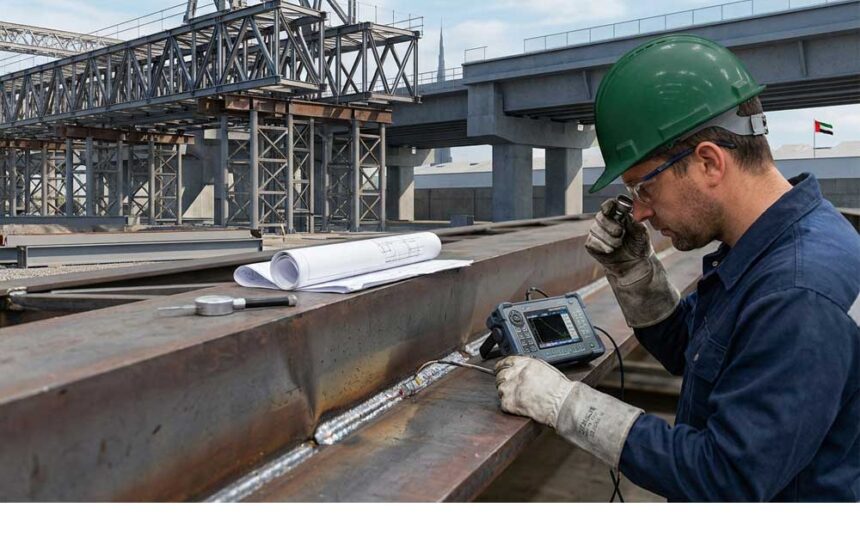
A weld can look perfect and still contain a defect that only becomes apparent when the structure is under load. That is why welding cannot be treated like a routine visual QA activity.
For structural steel projects, AWS D1.1 provides the framework for qualifying, performing and inspecting welding. But good welding quality starts well before the inspector examines the finished weld. It begins with the right welding procedure, qualified personnel, appropriate materials and proper control of the welding process.
This is where welding engineering and welding inspection work together.
Why Welding Inspection Isn’t Just General QA
General QA is designed to identify visible defects, dimensional errors and process deviations across a wide range of construction and fabrication activities.
Welding requires a more specialized approach. A weld is a metallurgical joint, and its integrity depends on factors such as heat input, cooling rates, filler metal compatibility, joint preparation, welding parameters and the possibility of internal discontinuities that cannot be seen from the surface.
A competent welding professional needs to understand welding procedures, weld symbols, materials, processes and applicable acceptance criteria. The inspector then verifies that the work has been performed in accordance with those requirements. This is why welding inspection is a discipline of its own, and why competent welding engineering support can add value before, during and after fabrication
Where Welding Engineering Adds Value
Inspection tells you whether the completed work meets the specified requirements. Welding engineering looks at the technical basis behind the welding process itself.
An International Welding Engineer (IWE) brings engineering-level knowledge to areas such as:
- Welding procedure development and review
- WPS/PQR evaluation
- Welder and welding operator qualification
- Welding process and consumable selection
- Material and weldability considerations
- Welding parameters and fabrication controls
- Assessment of welding defects and corrective actions
- Welding documentation and quality requirements
- Technical support during fabrication and inspection
For complex fabrication and EPC projects, involving appropriate welding expertise early can help identify potential problems before they become costly rework or inspection failures.
Welding inspection is not simply about finding defects after the weld has been completed, It starts with understanding the engineering, the procedure, the material, the welding process and the applicable code
AWS D1.1 Requirements EPC Contractors Commonly Miss
AWS D1.1 is frequently referenced on structural steel projects. However, referencing the code and demonstrating compliance with it are two different things.
One common issue is scope confusion. AWS D1.1 applies to welded structures and structural steel applications within its defined scope. It should not automatically be assumed to apply simply because a project involves welded steel. Pressure vessels, piping, aluminium structures and other applications may fall under different codes and standards.
Welder and procedure qualification is another area where gaps can occur. Personnel and procedures need to be appropriately qualified for the processes, materials, positions and joint configurations being used.
Then there is documentation.
Qualified welding procedures, welder qualification records and inspection documentation need to provide a clear trail connecting the approved requirements to the actual fabrication work. Missing, incomplete or inconsistent records can become a significant issue during client audits, inspections or project handover.
Visual Inspection vs. NDT
Visual inspection remains the first line of defence.
A competent inspector examines weld size, profile, surface condition and visible discontinuities such as undercut, overlap and surface porosity. It is an essential part of welding inspection and is applied before additional NDT is considered. But visual inspection has limitations. It cannot identify many internal or subsurface discontinuities. Depending on the application and project requirements, additional NDT methods may therefore be required.
- Ultrasonic Testing (UT) can identify internal discontinuities such as lack of fusion and certain types of cracking.
- Radiographic Testing (RT) provides an image of internal weld conditions and can be particularly useful where a permanent radiographic record is required.
- Magnetic Particle Testing (MT/MPI) is used to identify surface and near-surface discontinuities in suitable ferromagnetic materials.
The appropriate method and extent of examination should always be determined by the applicable code, design requirements, joint criticality and project specification.
PTC combines welding inspection capabilities with welding engineering expertise, including IWE competency, to support clients with WPS/PQR review, welder qualification, welding technical support, fabrication inspection and NDT requirements.
What Happens When Welding Doesn’t Comply?
A non-compliant weld is more than a documentation issue. At the immediate level, it can result in repair and rework; cutting out and rewelding a joint, repeating NDT and potentially delaying the project.
At the project level, repeated welding defects can lead to inspection failures, schedule delays, additional costs and disputes over acceptance.
More importantly, structural welding exists to transfer loads safely. The consequences of an undetected or improperly evaluated defect can extend well beyond the fabrication shop. This is why welding quality should be approached as a process, rather than simply as a final inspection activity.
The Bottom Line:
Good welding inspection is not simply about finding defects after the weld hasbeen completed.
It starts with understanding the engineering, the procedure, the material, the welding process and the applicable code, and then verifying that the fabrication has been executed accordingly.
For projects governed by AWS D1.1 and other applicable welding standards, the combination of competent welding engineering and inspection provides a stronger approach to quality assurance.
PTC combines welding inspection capabilities with welding engineering expertise, including IWE competency, to support clients with WPS/PQR review, welder qualification, welding technical support, fabrication inspection and NDT requirements.
Whether you are an EPC contractor, fabricator or asset owner, involving the right welding expertise early can help reduce rework, strengthen compliance and improve confidence in the final product.
Talk to PTC about your welding engineering and inspection requirements.
#CorrosionUnderInsulation #CUIInspection #NDTTesting #PulsedEddyCurrent #GuidedWaveTesting #AssetIntegrity #IndustrialInspectionUAE #CorrosionManagement #PTCInspect #OilAndGasUAE