
Third-Party Inspection vs In-House QA: What’s the Real Difference?
Ask ten people in manufacturing or construction what the difference is between third-party inspection and in-house QA, and you’ll get ten slightly different answers. Some will say it’s just about who signs the paperwork. Others will say one is “more official” than the other. Neither answer really gets to the point.
The real difference comes down to three things: scope, independence, and liability. Once you understand those, the rest of the decision (which one you need, when, and why) starts to make a lot more sense.
Scope: What Each One Actually Covers:
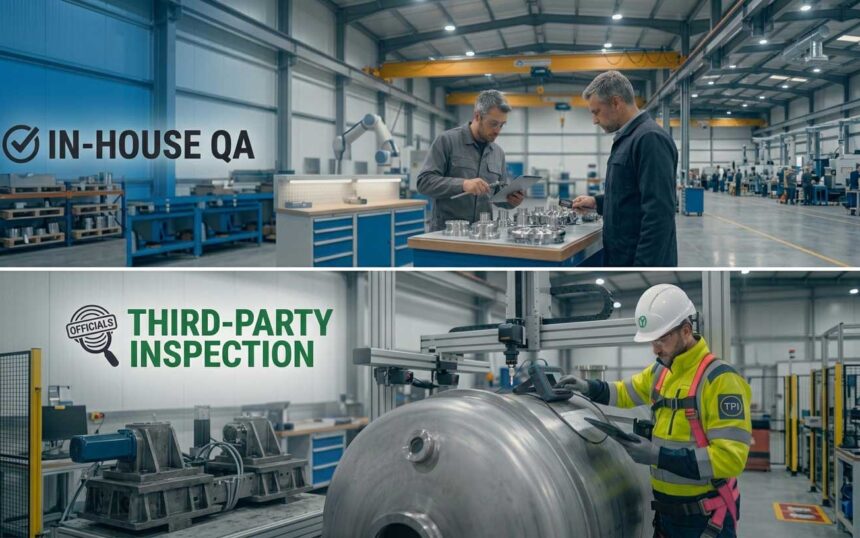
In-house QA teams exist inside your organization, working within the systems, timelines, and priorities of that organization. Their job is to catch problems early, keep production moving, and make sure internal standards are met before a product or project moves to the next stage. That’s valuable work, and no serious operation should skip it.
Third-party inspection is different by design. An outside inspector isn’t reviewing your work to help your team hit a deadline. They’re reviewing it against a fixed, external standard, whether that’s an ASME code, a client specification, or a regulatory requirement, and their conclusions aren’t shaped by your internal pressures. Their scope is narrower in one sense (they’re not managing your whole quality process) but broader in another, because their sign-off has to satisfy people outside your company: regulators, clients, insurers, code officials.
Independence: The Part Most People Underestimate
This is where the real gap shows up. In-house QA reports to someone inside the company. Even the most rigorous internal inspector is, at the end of the day, part of the same organization that benefits from the project moving forward. That doesn’t mean internal QA teams are dishonest. It means they’re structurally not independent, and independence is exactly what regulators, clients, and code bodies are looking for.
Third-party inspectors have no stake in whether your project ships on time or under budget. Their only job is to confirm whether the work meets the standard it’s supposed to meet. That separation is the entire reason third-party inspection exists as a category. It’s not a redundant layer of paperwork. It’s a different kind of check, built specifically so nobody has to just take your word for it.
The mistake some companies make is treating this as an either/or decision. In reality, the two work best together. In-house QA catches issues early, keeps day-to-day quality on track, and reduces the number of problems that ever reach a third-party inspector in the first place.
Where In-House QA Falls Short on Regulatory Acceptance
Here’s the part that catches a lot of companies off guard: many codes, jurisdictions, and clients simply won’t accept an internal sign-off as sufficient, no matter how good your QA team is. ASME code work, boiler and pressure vessel certification, and various NBIC repair and alteration processes all require inspection by an authorized, accredited third party. An internal inspector, even one with excellent technical judgment, doesn’t carry that authority.
This isn’t a knock on in-house teams. It’s simply that regulatory frameworks are built around the idea of independent verification. A company confirming its own work meets its own standard isn’t the same as an outside party confirming it meets an external one. For anything that needs to be legally certified, put into service, or accepted by a jurisdiction, in-house QA alone usually won’t clear the bar.
When You Need Both, Not One Instead of the Other
The mistake some companies make is treating this as an either/or decision. In reality, the two work best together. In-house QA catches issues early, keeps day-to-day quality on track, and reduces the number of problems that ever reach a third-party inspector in the first place. Third-party inspection then confirms, from the outside, that the finished work actually meets code and satisfies whoever needs to sign off on it.
Skip in-house QA, and you’ll send more failed work to your third-party inspector, costing time and money. Skip third-party inspection where it’s required, and your project may not be legally accepted at all, regardless of how well your internal team performed.
A Simple Way to Decide What You Need
Ask two questions. First, does this project need to satisfy a code, regulation, or outside client requirement? If yes, you need third-party inspection, no matter how strong your internal QA is. Second, do you want to catch problems before they reach that stage? If yes, in-house QA is worth having regardless.
Most serious projects need both. The question isn’t which one is better. It’s understanding what each one is actually for.
PTC is an ADNOC Approved third-party inspection provider helping companies meet code requirements with confidence. Get in touch to find out what your next project actually requires.
#ThirdPartyInspection #QualityAssurance #ASMECompliance #PressureVessels #InspectionServices #IndustrialSafety #NBIC #QualityControl #PTCInspect #RegulatoryCompliance