
Blogs

Eddy Current Testing for Heat Exchanger Tubes: What It Finds and When to Use It

Eddy-Current-Testing-for-Heat-Exchanger-Tubes

Heat exchangers do quiet work. In a refinery or petrochemical plant, they move heat between process streams through bundles of thin tubes, hundreds or even thousands in a single unit. When one tube leaks, product can contaminate the other side, efficiency drops, and an unplanned shutdown can follow. The trouble is that a heat exchanger tube fails from the inside out, long before anything shows on the outside.


That is the gap Eddy Current Testing (ECT) was built to close.


How ECT Works:


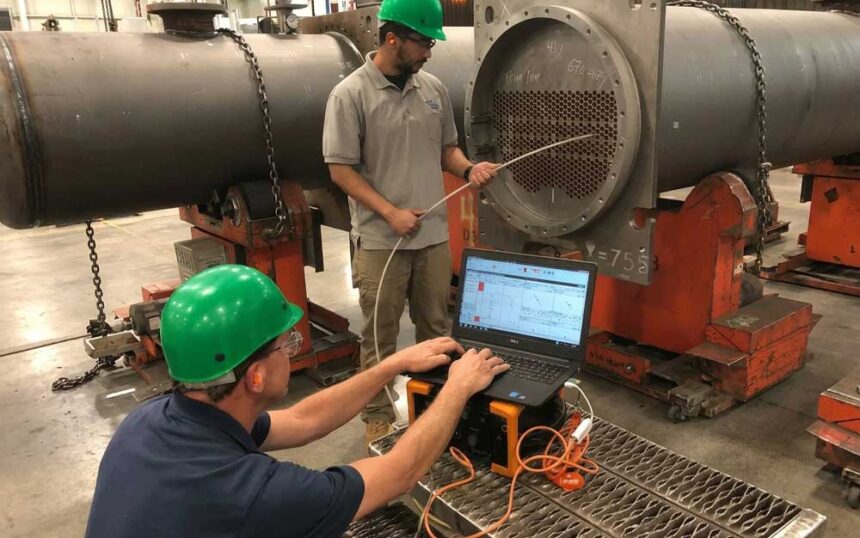
A probe is pulled through the tube. It carries a coil that produces a changing magnetic field, which in turn induces small electrical currents, called eddy currents, in the tube wall. Pitting, thinning or cracking disturbs those currents, and the instrument records the change. A trained analyst then reads the signal to work out what type of flaw it is and where it sits along the tube.


The result is not a simple pass or fail. ECT doesn’t just tell you a tube is damaged. It tells you where, and roughly how badly.

What ECT Typically Finds

  1. Pitting and localized corrosion
  2. Wear and fretting where tubes pass through support plates and baffles
  3. Wall thinning and erosion
  4. Cracking, depending on its orientation and the probe used
  5. Dents and other deformation

Where ECT Fits Best


ECT works best on non-ferromagnetic tubing such as copper alloys, brass, titanium and many stainless steels, common in condensers, coolers and process exchangers. Carbon steel tubes behave differently, because their magnetic properties interfere with a standard eddy current signal. For those tubes, other techniques are usually a better fit, including IRIS (Internal Rotary Inspection System), which we compare with ECT in a separate article.


Choosing the method before the shutdown, not during it, saves time and avoids re-testing.

A heat exchanger tube fails from the inside out, long before anything shows on the outside

What ECT Needs From You


Good data starts with good preparation.

  1. Clean tubes. Deposits and scale can mask defects and snag the probe. Most plants hydroblast or otherwise clean the bundle before inspection.
  2. Clear access. Tube ends must be exposed and free of obstruction, and the bundle should be staged where the team can work safely.
  3. Tube identification. A numbered tube map means every finding can be traced to a specific tube and found again at the next inspection.
  4. Reference standards. Calibration tubes that match the material, diameter and wall thickness of the tubes under test give the analyst a reliable baseline.

Understanding the Limits


No technique does everything. ECT is highly sensitive to small defects, but interpretation depends on analyst skill, and signals from support plates, the tube sheet and deposits can complicate the picture. Cracks near the tube sheet or in bends may need extra care or a complementary technique. A sound inspection plan states these limits up front rather than after the report is issued.

ECT doesn’t just tell you a tube is damaged. It tells you where, and roughly how badly

Why It Suits Shutdowns and Turnarounds


Turnarounds run on tight schedules, and every day an exchanger sits open costs money. ECT is fast per tube, produces a digital record, and allows results to be compared from one inspection cycle to the next. Compare findings across cycles and you can see how quickly damage is progressing. That turns the decision to plug, retube or keep running into an engineering call instead of a guess.


Talk to PTC:PTC provides heat exchanger tube testing using ECT and IRIS, supporting inspection during turnarounds and shutdowns. If you have an exchanger coming up for inspection, talk to PTC about the right approach for your tubes and your schedule.

#EddyCurrentTesting #ECT #HeatExchangerInspection #TubeInspection #Turnaround #Shutdown #AssetIntegrity #AdvancedNDT #UAEIndustry #PTCUAE

Cart (0 items)
Select the fields to be shown. Others will be hidden. Drag and drop to rearrange the order.
  • Image
  • SKU
  • Rating
  • Price
  • Stock
  • Availability
  • Add to cart
  • Description
  • Content
  • Weight
  • Dimensions
  • Additional information
Click outside to hide the comparison bar
Compare