
DIGITAL TRANSFORMATION IN INSPECTION: DRONES, ROBOTICS, AND REAL-TIME REPORTING
A few years ago, inspecting the inside of a storage tank or the underside of an offshore platform meant scaffolding, confined space entry permits, and a crew waiting on standby in case something went wrong. A lot of that is changing, not because the underlying inspection requirements have changed, but because the tools available to meet them have gotten dramatically better. The question most operators are actually asking now isn’t whether to adopt this technology, it’s which parts of it are ready today and which parts still need another year or two.
Drones and ROVs for Hard-to-Access or Hazardous Points
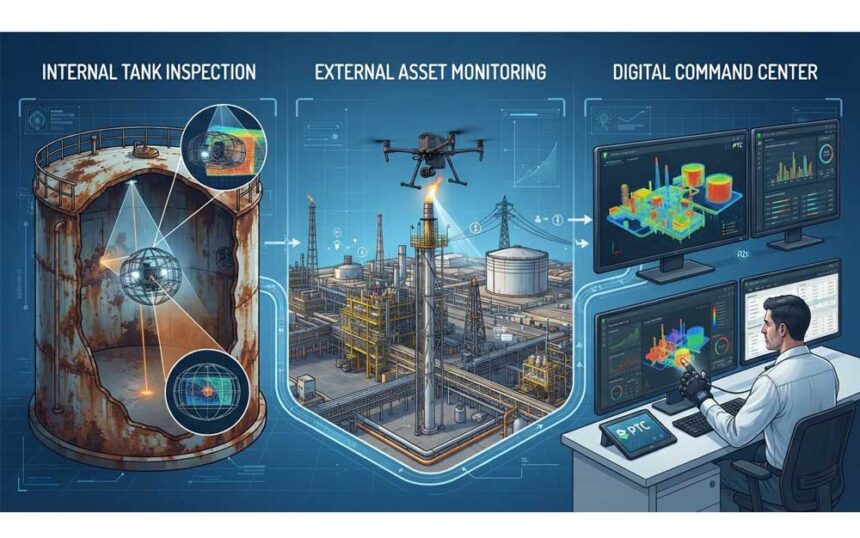
Flare stacks, tank roofs, elevated structures, and offshore platform undersides have always been expensive and risky to inspect the traditional way, usually requiring rope access, scaffolding, or a full shutdown just to get someone safely in position. Drones have largely closed that gap for anything above ground or at height. A properly equipped inspection drone can capture high-resolution visual and thermal imagery of a flare tip or tank roof in a fraction of the time it would take to rig access, and it does it without putting anyone at elevation.
Confined space work has followed a similar path, just with more specialized equipment. Purpose-built drones designed for tanks, vessels, and enclosed structures now operate in GPS-denied, zero-visibility environments using onboard lighting, collision-avoidance sensors, and gas detection payloads. That means an internal tank inspection that used to require confined space entry, with all the permitting and standby rescue requirements that come with it, can increasingly be done without a person ever going inside.
Below the waterline, remotely operated vehicles handle the same role for subsea assets. Pipeline sections, platform foundations, and submerged joints that were previously accessible only to divers can now be inspected by ROVs capable of working at significant depth and in difficult conditions, cutting both cost and risk substantially.
A properly equipped inspection drone can capture high-resolution imagery in a fraction of the time, without putting anyone at elevation or inside a hazardous confined space
Digital Reporting and Real-Time Defect Mapping
Capturing the data is only half the value. What’s changed just as much is what happens to that data afterward. Traditional inspection reports were static documents, a PDF with photos and findings that got filed away until the next scheduled inspection. Digital reporting platforms now let inspection data feed directly into structured, searchable records, often tagged to a specific location on the asset itself.
Defect mapping takes this further. Instead of a general note that “corrosion was observed near the north nozzle,” photogrammetry and LiDAR-based capture can build a spatial model of the asset with defects located precisely, measured, and tracked. Run the same inspection again next cycle, and the same defect can be compared directly against its previous state, showing whether it’s stable, growing, or has already been repaired. That kind of change-over-time tracking is far more useful for engineering decisions than a fresh, disconnected report every time.
Instead of a static PDF report that gets filed away, digital platforms build a spatial model where defects are located precisely, measured, and tracked over time.
IoT-Enabled Continuous Monitoring for Critical Assets
Periodic inspection, even done well, still leaves gaps between visits. IoT-based monitoring is starting to close those gaps for the assets where continuous data actually matters. Fixed sensors tracking vibration, temperature, pressure, or corrosion rate can flag a developing problem long before the next scheduled inspection would have caught it.
This isn’t a replacement for physical inspection, and it’s not meant to be. It’s a way of prioritizing where physical inspection resources go. A pipeline segment or vessel showing a stable sensor trend can safely wait for its normal inspection interval, while one showing an abnormal trend gets moved up the schedule. Used well, continuous monitoring turns inspection planning from a fixed calendar into something that actually responds to real asset condition.
What’s Realistic for UAE Operators Right Now
Drone inspection for elevated and hard-to-access structures is the most mature part of this shift and the easiest to adopt today. The technology is proven, and the regulatory path is clear: commercial drone operations in the UAE require GCAA registration, a licensed remote pilot, and operational approval before each flight, with additional restrictions around critical infrastructure like oil and gas facilities. None of that is a barrier, it’s simply a process to plan around, and most established inspection providers already work within it routinely.
Confined space and ROV inspection are close behind, with the equipment and expertise increasingly available locally rather than needing to be flown in for a single project.
IoT-based continuous monitoring is the piece that’s still earlier in its adoption curve for most operators here. The technology works, but it requires more upfront investment, integration with existing systems, and a data strategy that many facilities haven’t fully built out yet. This is realistically a next-phase adoption rather than an immediate one for most assets, best started on the highest-value or highest-risk equipment rather than rolled out everywhere at once.
The practical path for most operators is straightforward: bring in drone and ROV inspection now, since the technology and regulatory framework are both ready, and treat continuous monitoring as something to pilot on a small scale before scaling it up.
PTC is continuously developing and combining traditional inspection methods with digital reporting to give clients a clearer, more current picture of asset condition. Get in touch to see what fits your inspection program today.
#DigitalTransformation #DroneInspection #ROVInspection #IoTMonitoring #IndustrialInspectionUAE #AssetIntegrity #PredictiveMaintenance #InspectionTechnology #PTCInspect #OilAndGasUAE